Learn why the Colorado Forward Party supports ranked-choice voting
Do you find yourself routinely voting for the ‘lesser of two evils’ because you are simply not inspired by any of the candidates? That has become the norm in US politics. In our divided country few candidates command over 50% of the popular vote anymore.
This is a flaw in our election system. It happens partly because candidates who we ultimately choose from are first chosen in earlier party primary elections, and those who vote in party primaries tend to be the most partisan and most extremist voters (sometimes candidates are chosen by as little as 10% of voters, and these tend to be the most extreme and partisan voices). The candidates who make the general election have to first appease this extreme crowd.
So even though the average voter does not want an ideological warrior who refuses to compromise, when the general election comes that voter often must choose between partisan ideologues who will not compromise because of the fear of alienating their base.
The average voter wants someone who can deliver real solutions, and democracies function best when politicians work together and compromise. An electoral system that punishes compromise is harmful to democracy.
This brings us to the main effect of ranked-choice voting (RCV). Under RCV (just as in current elections), voters vote only once. The difference is that instead of choosing only their top pick, voters ranking all the available candidates from best to worst. For example, say I prefer for candidate ‘A’. With RCV, my ballot would specify candidate ‘A’ as my first choice but would also follow with my second, third, and fourth choices, perhaps ‘B’, ‘C’, ‘D’:
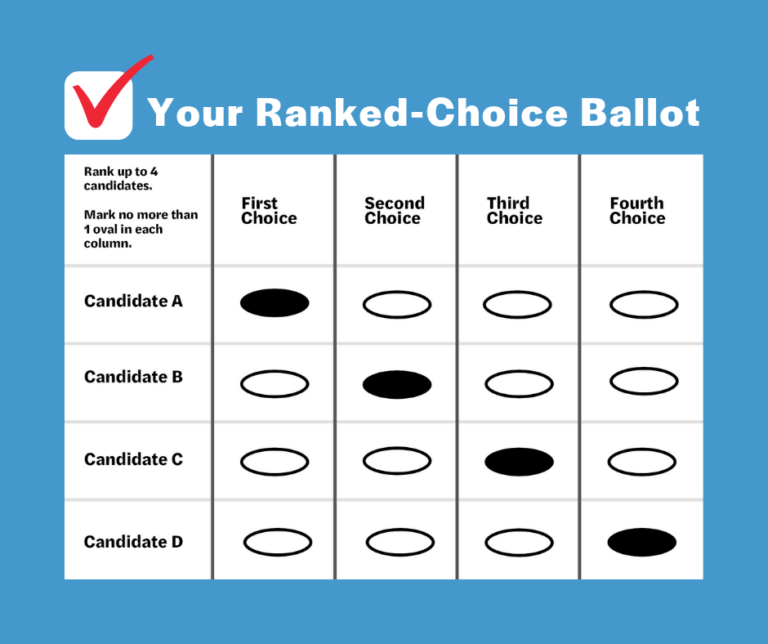
If a candidate wins over 50% of the popular vote, meaning they have broken out of the ‘lesser of two evils’ category, again nothing changes. RCV doesn’t kick in and the election finishes as it always has.
It is when no candidate wins over 50% that RCV works its magic. RCV takes into account each voter’s additional choices (the number of which varies with the RCV implementation selected), until one candidate gets over the 50% threshold. That candidate is the winner.
RCV rewards candidates who work to appeal to the broadest cross section of voters, rather than the candidate who divides us best (it should be obvious in our political climate that it is easier to divide people with vitriol and demonization than it is to unite and inspire people; candidates are forced, often reluctantly, to take advantage of this human reality).
Importantly, RCV works to amplify the voice of the voter above the voice of the established political parties, who often leverage this toxicity to maintain their power. Elections that more perfectly reflect the will of the voter is not a partisan issue.
To learn more about ranked-choice voting, watch:
- a 1.5-minute 'How ranked choice voting works' explanation from FairVote.org and
- an excellent 10-minute TED talk by Forward Party co-founder Andrew Yang.
Help the Colorado Forward Party grow by affiliating with us. It is cost-free! Click here to learn more.
